
She typed our name into a search bar: Angie's story
January 20, 2026 · Allison Brown
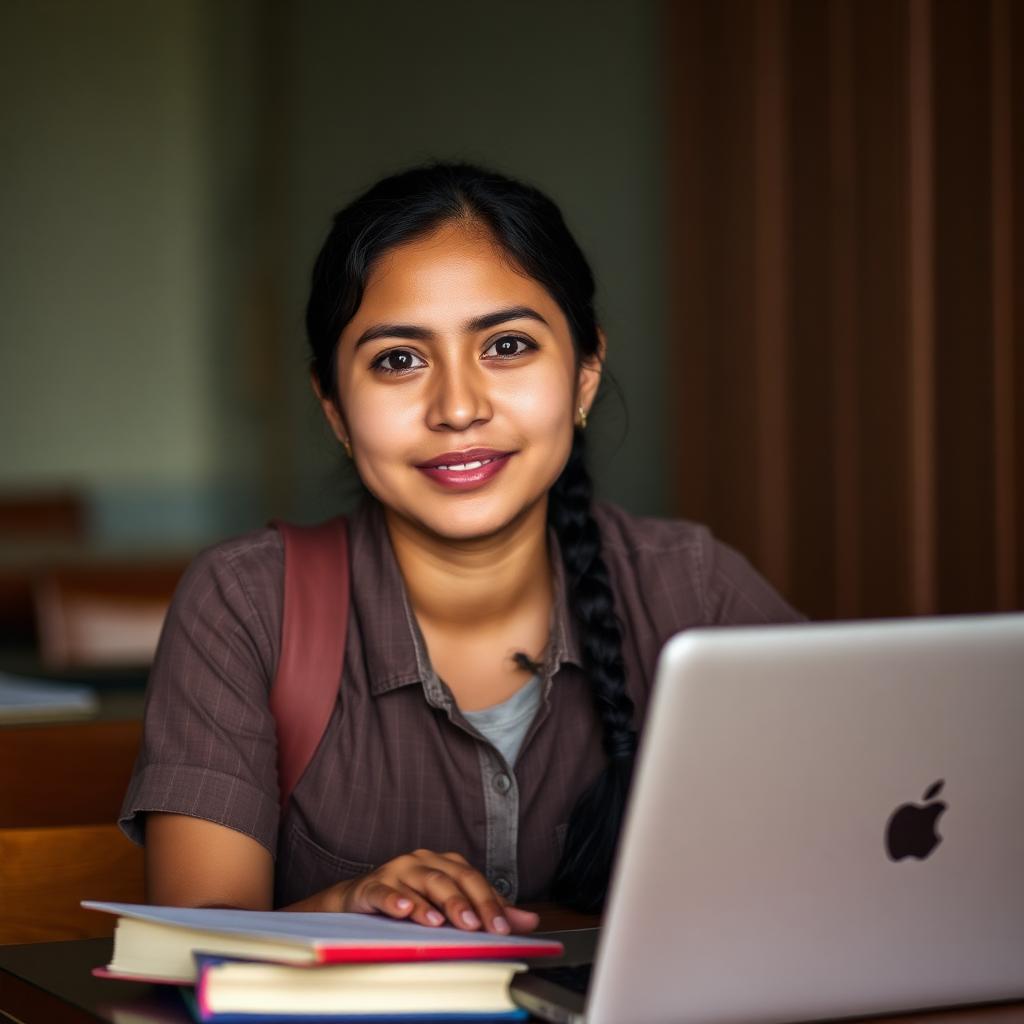
The story of Angie — who found us by faith, stayed home by choice, and is just getting started.
Every scholar in our program has a story about how they found us.
Most of them I had known for years before Hope Scholars Honduras existed — children I had watched grow up, families I had sat with in hard seasons, young people whose potential I had been quietly tracking for a long time. The relationship came first. The scholarship came later.
Angie found us on the internet.
She was eighteen years old, living in La Ceiba, working full time to help support her mother and grandparents, trying to hold onto her dream of a university degree and losing the fight. She didn't know us. She didn't have a connection or a referral. She just typed words into a search bar, found our website, and wrote us a letter.
That letter stopped me.
Who Angie Is
Angie graduated from a private Christian school — on scholarship, because her family could not afford the tuition. She was salutatorian of her class. She was a distinguished Honor Society member. She developed strong English skills, which her school gave her, and which she uses with a precision and warmth that are entirely her own.
She had been promised a university scholarship through her school. When the time came, the funding wasn't there. That is a particular kind of disappointment — the kind that arrives dressed as a promise.
So she tried to do it herself. She enrolled. She worked full time. She helped her mother with debts. She helped her grandfather — a taxi driver, the quiet anchor of their household — keep things together with her grandmother. She did all of it at once until she couldn't anymore. Not because she gave up, but because she was honest enough with herself to recognize that the math simply didn't work. Working full time and studying full time while supporting a family is not a schedule. It is an unsustainable emergency.
She didn't want to stop studying. She just needed a way to not have to choose.
The Letter She Wrote
Her initial email to Hope Scholars Honduras was not what you might expect from someone asking for help. It was composed, thoughtful, and entirely without self-pity. She introduced herself, described her situation plainly, named her dream — health sciences, specifically dental surgery — and then said something that I have thought about many times since:
“I am willing to accept any career path you see fit for me and would embrace this opportunity with gratitude and full commitment. I am also open to studying at any university you consider best for me.”
That is not passivity. That is trust. There is a significant difference.
When she submitted her formal application and wrote her thank-you note, she made a deliberate choice to write it in English. She explained why: “I know that reading it in your native language will convey deeper gratitude and feel warmer and more sincere.”
*She was eighteen years old. What eighteen year old thinks like that. *
The Decision to Stay
The path to dental surgery — her first dream — would have required moving to San Pedro Sula. The program isn't offered in La Ceiba. As she researched the logistics, something else became clear to her: she did not want to leave her family. Not because she was afraid, but because she looked at her grandfather and her mother and understood that her presence was part of what held things together.
She prayed about it. A lot. And she chose to stay.
She enrolled in Human Relations at UTH, a program available right there in La Ceiba. It was not the surrender of a dream. It was the decision of a young woman who knows what she values and refuses to pretend otherwise. She carries her responsibility for her family simply and without resentment — not as a burden she is trapped under, but as a commitment she has chosen to honor. She is looking for a way to manage all of it. She uses her faith as the source of strength to do that.
There is something unusual about her in this regard — a balance I don't often see. She accepts responsibility for others without sacrificing her own dreams. She doesn't frame these things as being in conflict. She just keeps solving the problem until she finds a way to hold both.
The Interview
When we met for her interview, Angie was nervous. Visibly so. I tried to put her at ease, to make it a conversation rather than an interrogation, and she relaxed and did beautifully. She is intelligent, a good listener, and a natural communicator in both English and Spanish. She is also lighthearted in a way that catches you off guard — she smiles easily, laughs genuinely, and engages with a warmth and honesty that feel entirely unperformed.
Her nervousness told me something she didn't say out loud: this opportunity looked too good to be true, and she wasn't sure she was going to get it. She was going to interview as well as she possibly could and then leave the rest to God.
What she didn't know was that I had already read her application. I already knew her character. The interview, for me, was mostly about figuring out the practical details — because the honest truth was that I didn't have the funds to award her yet. I was hoping the board would find a way. She was hoping I would say yes.
We were both, without knowing it, waiting on the same answer.
Yes
At our end-of-year board meeting in December 2025, Angie was approved as a Hope Scholars Honduras scholar. She began receiving monthly support in January 2026.
Her first quarter grades: General Psychology 96. English 98. Technology 94. Statistics 94. Oral and Written Expression 87. Administration 93.
These are the grades of a young woman who has been carrying the weight of her family on her back for years. Now, for the first time, she doesn't have to work full time while she studies. She describes it simply: she feels lighter.
Lighter. Not carefree — she still shows up for her family, still attends her church, still dances on the worship team on Sundays. But lighter. Like someone who has been given just enough room to breathe and is discovering, perhaps for the first time, what it feels like to just be a student.
What Angie Said
In one of her early emails, before she knew whether we would say yes, Angie wrote this:
“I promise I will return the favor and give back to society if we are able to make this possible. I promise to become a donor myself when I grow up, because I know this path is not easy.”
She is eighteen years old. She was asking for help. And she was already thinking about the day she would be the one giving it.
This is why Hope Scholars Honduras exists. Not students who need rescuing. Students who are already everything they need to be — who just need someone to believe it, and to make it a little more possible.
Angie is just getting started. We cannot wait to see what comes next.
—